|
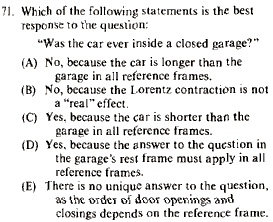
GR8677 #71
|
|
|
|
|
Alternate Solutions |
casseverhart13
2019-08-27 02:20:10 | Comfortably, this submit is often the very best for this problem subject. click here |  | torturedbabycow
2010-02-14 17:50:06 | dogsandfrogs explained it pretty well.
Once you've calculated both lengths in both reference frames, you'll see that whether the car "fits" in the garage also depends on the reference frame. (Which cuts out (A) and (C) immediately.) What this means is that the order of the doors opening/closing ALSO depends on the reference frame, since we're told that they do so automatically as soon as each end of the car passes.
This seems like it might be an issue for causality, but it isn't. (To be pedantic, it's not true that the order of putting-cake-in-mouth and eating-cake is relative - no matter what frame of reference you are in, putting-cake-in-mouth always comes first. Only when the second event is outside the "light cone" of the first can the order of events be reversed based on reference frame, since they're not causally related and it doesn't "matter" which one goes first. :P And that's why there's not really a paradox.) | |
|
|
Comments |
casseverhart13
2019-08-27 02:20:10 | Comfortably, this submit is often the very best for this problem subject. click here | | whereami
2018-04-09 02:01:42 | special relativity doesn\'t really change how things are, i think. It only supplies you with different coordinates of space and time. In this case no matter what frame you choose, the doors will be opened/closed at the moment when it is perceived to be needed to be opened/closed. \r\nIf you don\'t believe this you can calculate for both frames. \r\nAnswer is E bytheway. |  | gear3
2013-09-24 09:34:36 | I think D is the right answer.
At first,in the garage frame,the length of the car is 3m. We assume when the car's head goes to gate A, we close both gate A and B instantly AT THE SAME TIME.
Then, in the car frame, the garage is shorter than the car. When gate A hits the car's head, it closes,but gate B doesn't close(you can calculate it yourself.I just state the process).Then the car crashes, but you should notice the car's tail won't be damaged AT THE SAME TIME because the impact need time to go to the tail and its maximum speed is c. The garage's speed is 0.6c.
Anyway, although gate A is closed ,gate B isn't. After a few time, when gate B is closed the whole car is damaged in the garage.
Special relativity never violates the law of causation.
dochang
2017-10-17 18:12:32 |
Nope. E is indeed correct. Try solving the problem with a Minkowski diagram. It becomes immediately evident that after transforming from one reference frame to another, the simultaneity of the closing and opening of the doors is no longer preserved. Causality is also preserved because in both reference frames, the presence of the car causes the doors of the garage to open and close.\r\n
|
| | torturedbabycow
2010-02-14 17:50:06 | dogsandfrogs explained it pretty well.
Once you've calculated both lengths in both reference frames, you'll see that whether the car "fits" in the garage also depends on the reference frame. (Which cuts out (A) and (C) immediately.) What this means is that the order of the doors opening/closing ALSO depends on the reference frame, since we're told that they do so automatically as soon as each end of the car passes.
This seems like it might be an issue for causality, but it isn't. (To be pedantic, it's not true that the order of putting-cake-in-mouth and eating-cake is relative - no matter what frame of reference you are in, putting-cake-in-mouth always comes first. Only when the second event is outside the "light cone" of the first can the order of events be reversed based on reference frame, since they're not causally related and it doesn't "matter" which one goes first. :P And that's why there's not really a paradox.)
Almno10
2010-11-12 00:37:13 |
Imagine if you had a cadillac that could go the speed of light. Parking that thing would be rough.
|
| | justguessing
2009-09-26 09:03:33 | i believe the paradox arises from the fact that garage doors just dont open at the speed of light. It's takes like at least ten seconds.
sher
2010-01-07 11:11:34 |
it is very confusing
|
| | OrrinJelo
2009-08-06 17:16:57 | So the answer is E? Can anyone explain this better?
dogsandfrogs
2009-10-07 09:25:30 |
Yes, the answer is E. Think of both reference frames:
In the frame of the car, when it is passing through the garage, the car is 5 meters and the garage is 2.4 meters. Obviously in this frame the car is not contained within the garage at any point.
In the frame of the garage, the garage is 4 meters, and the car is 3 meters as it is passing through. In this frame, the car is short enough to be fully contained within the garage, with an entire meter to spare.
Because the car is in the garage and not in the garage depending on your choice of frame, there is no unique answer.
|
shak
2010-07-31 21:34:13 |
Thank you Dogsandfrogs
|
Setareh
2011-10-26 11:26:21 |
I loved your comment Dogsandfrogs..
|
| |
|
| Post A Comment! |
|
|
Bare Basic LaTeX Rosetta Stone
|
LaTeX syntax supported through dollar sign wrappers $, ex., $\alpha^2_0$ produces  . .
|
| type this... |
to get... |
| $\int_0^\infty$ |
 |
| $\partial$ |
 |
| $\Rightarrow$ |
 |
| $\ddot{x},\dot{x}$ |
 |
| $\sqrt{z}$ |
 |
| $\langle my \rangle$ |
 |
| $\left( abacadabra \right)_{me}$ |
_{me}) |
| $\vec{E}$ |
 |
| $\frac{a}{b}$ |
 |
|
|
|
|
The Sidebar Chatbox...
Scroll to see it, or resize your browser to ignore it... |
|
|
|