|
GR8677 #38
|
|
|
Problem
|
|
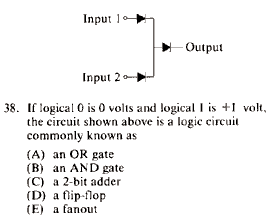 |
Advanced Topics }Logical Circuit }Logical Circuit
(A) This is the OR gate. Triangle with fat-end on input side denotes OR.
(B) Triangle with fat-end closer to output side denotes AND. (Pointy tip points to each input.)
(C) A 2 bit-adder involves more operations than this...
(D) A flip-flop is a sort of sandal that flips and flops. It might also flip the floating point.
(E) A fan-out describes the maximum number of outputs a circuit can excrete. (Fan-in would be inputs.)
|
|
|
Alternate Solutions |
casseverhart13
2019-09-09 09:44:15 | A great problem and a very explicit information of problem to solve for everyone. electrician Orlando |  |
|
|
Comments |
casseverhart13
2019-09-09 09:44:15 | A great problem and a very explicit information of problem to solve for everyone. electrician Orlando | | joshuaprice153
2019-08-09 04:11:16 | Terrific post, I’ve bookmarked this site so hopefully I will discover much more on this topic in the foreseeable future. mobile detailing Orlando |  | azwar33
2016-03-12 23:13:09 | this is\r\n\r\nhttp://goo.gl/mxSH7Q\r\n\r\nhttps://goo.gl/xKw64s\r\n\r\nhttps://goo.gl/rzvJTg | | justin_l
2012-11-08 10:59:58 | i love this website but this solution is flat-out wrong. Diodes do not denote 'or gates'. And if they were both facing the other way, it would not be an 'and' gate. The diodes are not logical gates at all.
Someone looking at this solution would be convinced that they had to memorize some magic about the shape of logic gates.
The only way to answer this question while understanding it is to make a truth table (explicitly or in your mind) of what outputs come from what inputs, keeping in mind that those are diodes (which are basically wires that only allow current in one direction)
Input 1 w/ Input 2 -> ?
0 w/ 0 -> 0
1 w/ 0 -> 1
0 w/ 1 -> 1
1 w/ 1 -> 1
this only matches with logical OR:
http://en.wikipedia.org/wiki/OR_gate
0 or 0 -> 0
1 or 0 -> 1
0 or 1 -> 1
1 or 1 -> 1
Which says "if either of the inputs are 1, the output should be 1. Otherwise, it's 0."
bzbee
2013-10-06 15:54:49 |
yea, i think this is the way to see it.
just run current through this circuit and see what comes out. if you apply current to either or both the top or bottom branch, a current will come out. if current isn't applied, then the output is zero.
that looks like
branch 1 / branch 2 / out
1 / 0 / 1
0 / 1 / 1
1 / 1 / 1
0 / 0 / 0
this is an OR truth table
|
| | CarlBrannen
2010-10-08 12:57:16 | I've made a good living designing electronics for 25 years and those little triangles with the bars are "diodes", not "or gates". The symbol for an OR gate is like a pointy bullet with a concave bottom. For it to be an OR gate there must be two inputs (on the concave end) and one output (at the pointy end).
A diode passes current only if its input voltage exceeds its output voltage. In general, there is a loss in voltage, called a "diode drop". This depends on the type of diode. For the usual silicon diode it's 0.6V, but for special diodes it can be as small as 0.3V. Consequently, whoever drew up the problem should have specified the "logical 1" voltage as a much larger voltage, maybe +5 or +10 volts.
See "logic gate" and "diode" at wiki.
faith
2010-10-23 00:18:02 |
agreed! very true. my answer was down to either A and E. i immediately eliminated A since those damn triangles were of diodes and not a gate.. and E i dunno what the heck was E. so.. damn..
|
| | Tevatron
2009-11-02 21:18:49 | This question was aggravating to me because I started thinking about the characteristic voltage drop that occurs over actual diodes (usually around .6V for a diode operating in forward bias), which would make the circuit practically worthless since you could never see a logical high out put when there's only a difference of 1 V between false and true.
I suppose you're supposed to assume the voltage drop across the diodes is negligible but in real-life, it does create some problems. (It's why pure diode logic is rarely used as chaining gates together creates floating outputs) | | spacemanERAU
2009-10-15 11:50:06 | I dont think the flip-flop they are referring to here is a sandal.
http://en.wikipedia.org/wiki/Flip-flop_(electronics) | | student
2007-01-24 11:26:28 | So what is the answer? | | wzm
2006-11-03 07:33:19 | If anybody is convinced that this as an AND, you may be confused by the identity of the circuit elements. These are diodes, they do nothing to the input voltage, they just hold the base of the output high if either (or both)input is high. If these were not gates,instead of diodes, as I originally thought, this would be an AND gate.
FortranMan
2008-10-26 12:36:37 |
Thanks for your explanation. For a good description of the difference between OR and AND gates: http://www.play-hookey.com/digital/electronics/dl_gates.html. Basically for an AND gate, the diodes for the input would have to be reversed and a voltage would have to be applied within the circuit between the input and output. So an AND gate works the opposite way, while an OR gate requires the current to flow in from at least one of the inputs, an AND gate requires that both inputs keep the current from flowing out except through the output.
A 2-bit adder usually consists of equal numbers of OR and AND gates used together. A flip-flop is a bit for storing memory and consists of two NOR gates (as in "not this nor that").
|
| | jax
2005-12-01 18:35:47 | I understand that this is an OR gate, but I don't understand the wording of this question. What is logical 1 and logical 0 ?
At first I thought they were calling the first diode logical zero and the 2nd diode logical 1 but this doesn't really make sense. Are they just saying 0 volts represents false and +1 volt represents true? Maybe its just me but I spent way too long thinking about this easy question just because of that wording...
wdmanegold
2005-12-02 01:20:33 |
|
wdmanegold
2005-12-02 01:26:56 |
Ok,
Jax,
0 V is logical 0 and +1 V is logical 1 *is* what you think; 0V equals false, and +1V equals true. This is because in some actual gates, the input is actually not-ed as it comes in; for example, many digital chips are set up where there are pins where a high voltage actually means false, and a low voltage means true.
For D), a flip-flop is sort of a clocked latch. Its essentially a contruct meant to store a logic value within the gate. It is made up of multiple basic gates; an example can be found here: http://wearcam.org/ece385/lectureflipflops/flipflops/
|
jax
2005-12-02 06:38:27 |
Yep, I know all of that, but the fact that logical zero = 0 and logical one = 1 has absolutely nothing to do with this problem... that's my point (once I understood what they meant by logical I was fine).
Logical zero and logical one could be just about anything and this would still be an OR gate! They just arbitrarily chose 0 and 1 and I spent too much time thinking about whether that had any significance (maybe they didn't use the word logical in my course for the true/false values, or maybe I forget since I took digital electronics 3 years ago!).
|
wdmanegold
2005-12-02 13:14:28 |
Well, the problem is that if they didn't include that, then it would be legitimate to look at it from the other way; that is, that +1V is logically 0, and that 0V is logically 1. If you do this, the circuit is actually an AND gate.
|
jax
2005-12-02 20:38:49 |
Ah yeah I guess you're right ! That would be one confusing and gate though ;)
|
sirius
2008-11-05 21:25:12 |
i agree that the hardest part of the problem was deciphering what they meant by "logical."
|
|  |
|
| Post A Comment! |
|
|
Bare Basic LaTeX Rosetta Stone
|
LaTeX syntax supported through dollar sign wrappers $, ex., $\alpha^2_0$ produces  . .
|
| type this... |
to get... |
| $\int_0^\infty$ |
 |
| $\partial$ |
 |
| $\Rightarrow$ |
|
| $\ddot{x},\dot{x}$ |
 |
| $\sqrt{z}$ |
 |
| $\langle my \rangle$ |
 |
| $\left( abacadabra \right)_{me}$ |
_{me}) |
| $\vec{E}$ |
 |
| $\frac{a}{b}$ |
 |
|
|
|
|
The Sidebar Chatbox...
Scroll to see it, or resize your browser to ignore it... |
|
|
|